
Rayagada, Sept. 10 (UDN): A wild tusker was killed after being struck by a train engine on the Bissamcuttack-Therubali railway section in Odisha’s Rayagada district late Tuesday night, prompting a joint investigation by railway and forest authorities.
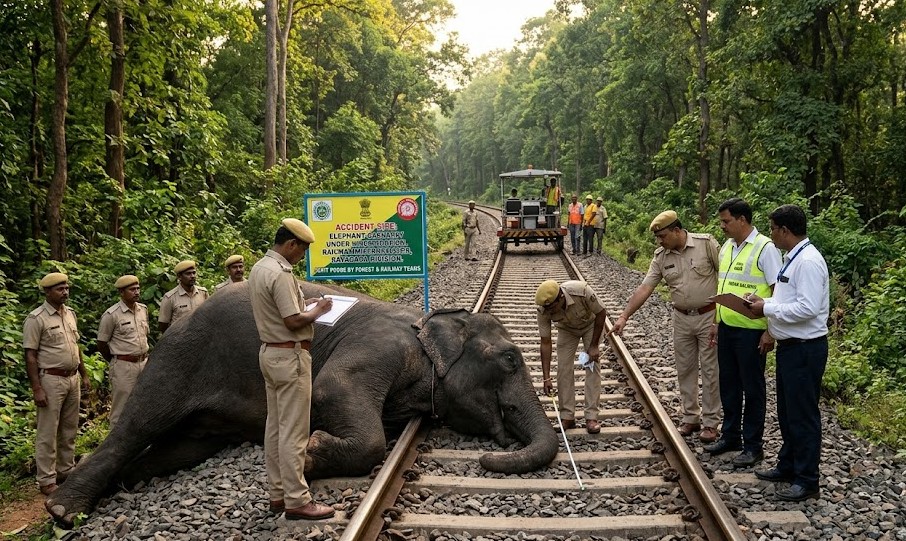
Representational Image
The elephant’s carcass was discovered nearly three metres away from the railway track on Wednesday morning, indicating that the impact had thrown the animal off the line. Officials from the Railway Police Force and the Forest Department rushed to the site, while an elephant response squad was deployed to assist with the operation.
Rescue delayed by heavy rain
Authorities said the carcass was lying on a sloping patch beside the railway line, allowing train services on the route to continue without disruption. However, persistent rainfall slowed recovery efforts as officials carried out inspections and completed the required legal and wildlife procedures.
The exact circumstances leading to the collision are under investigation.
Elephant-train collisions remain a challenge
The incident has once again highlighted the continuing challenge of preventing elephant deaths on railway tracks in Odisha, a state with one of India’s largest elephant populations.
According to the Annual Odisha Wildlife Report 2025, 842 elephants died in the state over the past decade, including 29 deaths caused by train collisions.
To reduce such accidents, the state government has introduced several mitigation measures, including AI-enabled surveillance cameras along vulnerable railway corridors. Forest officials say these systems have detected around 880 instances of elephants approaching railway tracks, allowing authorities to issue alerts in many cases.
Despite these interventions, wildlife experts say elephant-train collisions continue to pose a serious conservation concern, particularly in forested railway corridors where elephant movement intersects with rail traffic.
Leave a Reply