
Chandigarh University Launches C-Hub – Incubator of Incubators as National Consortium to Take Indian Startups from Ideas to Market
CHANDIGARH, India, Oct. 9, 2026 /PRNewswire/ — Aimed at strengthening access to early-stage investment for startups by connecting India’s incubation institutions with investors, industry and policymakers, Chandigarh University brought together more than 400 incubator institutions from more than 20 States and Union Territories, over 100 startups, 80 investors and more than 60 government, policy and industry delegates on a single platform at Incubator & Capital Summit 2026 and ISBACON 2026.
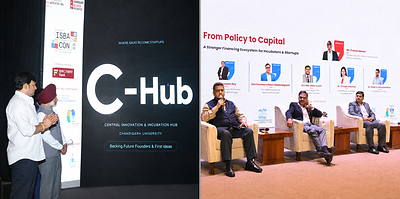
Hosted by Chandigarh University Technology Business Incubator (CU-TBI) in collaboration with the Indian Science and Technology Entrepreneurs Parks and Business Incubators’ Association (ISBA), the four-day mega summit brought together incubators, founders, investors, policymakers, industry leaders and academic institutions to expand collaboration around investment, co-incubation, research and industry partnerships, while connecting startups with mentors, capital, technology and market opportunities and enabling incubators to share cohorts, expertise and infrastructure for wider startup growth across India.
To create a national platform for scaling startup innovation across India, Chandigarh University launched the Central Innovation & Incubation Hub (C-Hub) as an ‘Incubator of Incubators’ Consortium, inaugurated by Gaurav Gautam, Minister of State, Youth Empowerment & Entrepreneurship, Sports, Law & Legislative, Haryana along with Member of Parliament (Rajya Sabha) and Chancellor Chandigarh University Satnam Singh Sandhu. The Hub will connect incubators and startup support institutions to facilitate shared cohorts, mentors, infrastructure and investor partnerships, while enabling startups to access wider incubation support, early-stage capital, industry connections and market opportunities across India.
Among the prominent personalities who participated in the summit were Rikant Pitte, Founder & CEO EaseMyTrip, Yoav Fekete, Innovation Attaché at Embassy of Israel, Prasad Menon, President, ISBA CEO, Centre for Incubation and Business Acceleration (CIBA), Raghavendra, Joint Secretary, Department for Promotion of Industry and Internal Trade (DPIIT), Shashank Randev, Founder, 247VC among others.
Speaking on the occasion, Gaurav Gautam, Minister of State, Youth Empowerment & Entrepreneurship, Sports, Law & Legislative, Haryana, said, “Indian youth have the responsibility of realizing Prime Minister Narendra Modi’s vision of a ‘Viksit Bharat 2047’ and make the nation lead the world across every sector, from startups and digital technology to incubators and new unicorns. India’s youth should not fear failure and keep striving to move forward. One day, your startup idea will serve the nation, benefit India and bring success. India’s youth should dream big as the nation is fully prepared today to give wings to their ideas.”
“Thanks to the talent of India’s youth and Prime Minister Narendra Modi’s vision of providing them with new platforms, things have changed in the country after 2014. India is now creating its own technology and we are moving beyond merely importing goods to excelling across every sector. Before 2014, we hardly ever heard terms like ‘Digital India’ or ‘startups’, mobile penetration was minimal and more than half of this country’s population was previously unconnected to the formal economy. Now though DBT (Direct Benefit Transfer) funds reach the accounts of people living in areas without internet access and UPI is being used by the common man. All this transformation is driven by India’s youth who are envisioning how to advance technology, champion new ideas and scale up startups. They are figuring out how to collaborate with incubators and engage with new investors, this is the spirit of India’s youth,” the minister added.
Member of Parliament and Chandigarh University Chancellor Satnam Singh Sandhu, said, “The vision and resolve of Prime Minister Narendra Modi for a ‘Viksit Bharat’ is coming true. India’s startup ecosystem and entrepreneurs will play the most significant part in transforming our country into a developed nation by 2047. India’s growing startup ecosystem, with around 2.25 lakh startups and over 125 unicorns, reflects the country’s entrepreneurial potential. However, the focus must now shift from increasing numbers to ensuring the quality, sustainability and global competitiveness of startups. Profitability is essential for the long-term sustainability of any venture. At the same time, strong leadership skills are equally important for both entrepreneurs and professionals to drive innovation and growth. Indian startups must focus on developing quality products and solutions that can compete globally and contribute meaningfully to the nation’s journey towards becoming a developed country by 2047.”
Yoav Fekete, Innovation Attaché at Embassy of Israel, said, “As Punjab’s agricultural strengths provide foundation for creation of valuable new material, bio-based eco-responsible packaging can be made from agricultural residue. It can not only add income for farmers but also provide an alternative to single-use plastics packaging. Our long-standing agricultural cooperation offers the foundation for an Indian-Israeli partnership to develop new opportunities after the harvest. Indian and Israeli researchers, entrepreneurs, and industrial partners should come together to co-develop such technology for locally available agricultural residues in North India and creating packaging for Indian businesses. This is an environmental and business opportunity. A reliable market for agricultural residue can create additional source of income for farmers and opportunities for local enterprises.”
“The world is standing at the crossroads today where AI can deepen the divide between the poor and the rich and those who own the tools and those who are only bound for them. But AI is also providing extraordinary possibilities in health, agriculture, education, manufacturing, and in how we care for our planet. Researchers have the responsibility of choosing what to build, founders need to choose what to sell, and investors choosing what to fund,” he added.
Prasad Menon, President, ISBA, said, “It’s early days for incubator movement in India. But given the diversity of India, it’s not just about numbers of incubators in the country, but it’s also about whether we have managed to reach and penetrate incubators across different states of India across different regions. I’m very proud to say that ISBA represents incubators from all across India and we attempt to ensure that all the voices, whether it is big or small, are heard. With all the development that India has seen over the years, startups can’t have a growth unless the ecosystem also grows. The number of incubators in India may not have grown proportionally with startup ecosystem, but incubators play major role in putting the startups in the front. When it comes to incubation, there’s nothing like one size fits all and diversity of our country needs diversity of incubator ecosystem.”
The summit brought together technology business incubators, Atal Incubation Centres, university innovation heads, IPR leaders, startup support institutions, investors, policymakers and corporate representatives from across the country. The summit was designed to facilitate collaboration between institutions that support startups at different stages, enable founders to access early-stage capital, create opportunities for co-incubation and corporate partnerships and develop stronger national innovation networks beyond the major startup centres.
The C-HUB is designed to bring niche incubators and venture-support activities together through shared programmes, investor relations, partnerships and a common technology and data platform. Alongside C-Hub, the University announced a co-incubation framework under which partner incubators can work with CU-TBI through shared cohorts, mentors and infrastructure. Joint cohorts with venture capital firms were also announced, creating a structured channel through which participating funds can engage with CU-incubated ventures.
Chandigarh University also signed MoUs with 100 leading incubators across India to establish joint cohorts and co-incubation programmes, enabling greater collaboration, shared expertise and resources to support startup growth and scale ventures nationwide.
The summit featured focused discussions on entrepreneurship, networked incubation, deep-tech and startup financing. Rikant Pittie, Co-founder, EaseMyTrip, shared his journey from bootstrapping to public markets, while Raghavendra, Joint Secretary, DPIIT; Dr. Basant Garg, IAS, Administrative Secretary, Industries & Commerce and IT, Government of Punjab; Atul Kumar, Director, Data Security Council of India and P. J. Singh, CMD, Tynor Orthotics and Vice President, CII, discussed how policy, industry and regional hubs can strengthen startup outcomes. Dr. Panneerselvam Madanagopal, CEO, MeitY Startup Hub; Dr. K. Suresh Kumar, Executive Director, PSG-STEP and Dr. Praveen Roy, Scientist ‘G’ and Head, TTI Division, DST, explored deep-tech capabilities for incubators, while Dr. Dhananjay K. Tiwary, Managing Director, BIRAC; Jai Shah, Principal Investment Officer, NEEV Fund, SBI Ventures and Vipul Patel, Partner – Seed Investing, IIMA Ventures, discussed stronger financing pathways for startups and incubators. The Microsoft UNNATI AI 2.0 Roadshow brought together representatives from Microsoft, FITT-IIT Delhi, iHub, India Accelerator and TiE Delhi for discussions around AI and the startup ecosystem. The summit’s four-day programme further includes the Startup Expo, incubator exchange, masterclasses, policy roundtables, investor meetings, Demo Day and industry engagement, providing multiple opportunities for startups and incubation institutions to move from introductions to concrete collaborations.
Chandigarh University Maps 51 National Centres of Excellence for Collaboration
CU-TBI has mapped 51 Centres of Excellence across India as potential collaborators, comprising 35 academic, 14 government, one industry-academia and one non-profit research institute. Hosted at institutions including IISc, IITs, IIM Ahmedabad, STPI, NIELIT, ICMR and CSIR, these centres span quantum technology, AI, robotics, chip design, healthcare, materials, defence and financial markets, opening avenues for research, technology collaboration and stronger support for innovation-driven startups.
About Chandigarh University
Chandigarh University is a NAAC A+ Grade University and QS World Ranked University. This autonomous educational institution is approved by UGC and is located near Chandigarh in the state of Punjab. It is the youngest university in India and the only private university in Punjab to be honoured with A+ Grade by NAAC (National Assessment and Accreditation Council). CU offers more than 109 UG and PG programs in the field of engineering, management, pharmacy, law, architecture, journalism, animation, hotel management, commerce, and others. It has been awarded as The University with Best Placements by WCRC.
Website address: https://www.cuchd.in/
 View original content to download multimedia:https://www.prnewswire.com/in/news-releases/chandigarh-university-hosts-national-incubator–capital-summit-and-isbacon-2026-bringing-400-incubators-80-investors–100-startups-together-to-strengthen-indias-startup-ecosystem-302903489.html

Leave a Reply