
Pic Credit: https://x.com/paradipport
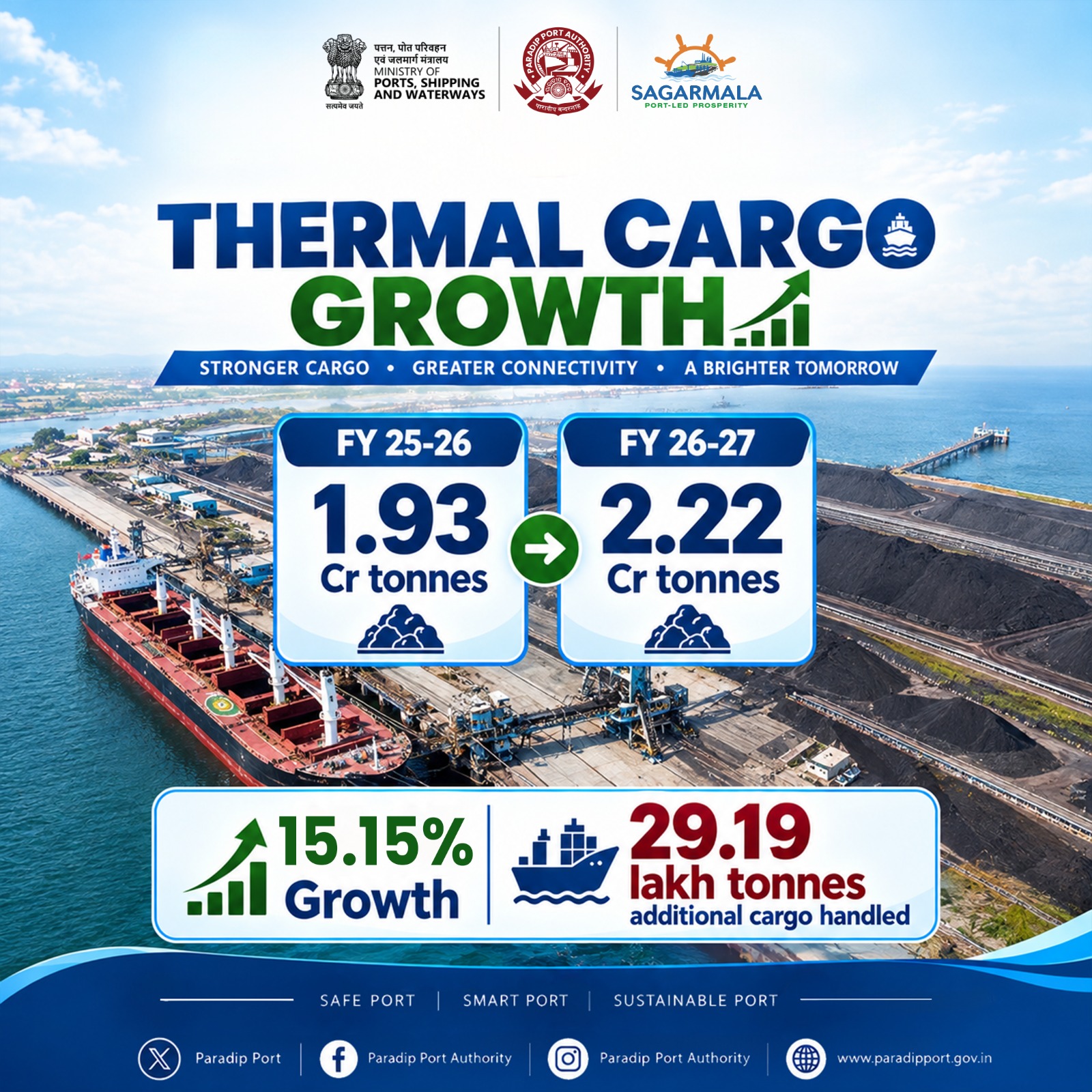
Paradip Port is strengthening its position as a major energy and bulk-cargo gateway on India’s eastern coast, with thermal cargo handling registering a 15.15 per cent increase.
Thermal cargo volumes have risen from 1.93 crore tonnes to 2.22 crore tonnes, adding nearly 29.19 lakh tonnes to the port’s throughput. The increase comes as Paradip expands its cargo-handling capacity and invests in faster, more mechanised logistics infrastructure.
The latest growth is significant for the wider business ecosystem because thermal cargo movement connects ports with power generation, manufacturing, mining, railways, road transport and other industrial supply chains.
Rising Cargo Reflects a Larger Logistics Opportunity
For a port such as Paradip, higher thermal cargo volumes are not simply a measure of tonnes handled. They indicate greater activity across the logistics chain.
Coal and other bulk energy commodities need to move efficiently from vessels to storage facilities and onward through rail and road networks. Any improvement in vessel turnaround, berth productivity or cargo evacuation can therefore influence the efficiency of the broader supply chain.
Paradip Port handled a record 156.45 million tonnes (MMT) of cargo in FY2025-26, marking its highest-ever annual throughput and a 4.01 per cent increase over the previous year. Coastal cargo accounted for 65.81 MMT, or 42.06 per cent of total cargo.
Business Activity Extends Beyond Thermal Cargo
The port’s recent performance shows that its growth is becoming broader than a single commodity.
According to Paradip Port Authority, coal handling grew 4.44 per cent in FY2025-26, while steel cargo rose 43 per cent and petroleum, oil and lubricants cargo increased 25.68 per cent. LPG handling recorded a particularly sharp 105 per cent rise.
This diversification matters for the port’s business prospects because different cargo streams create demand for terminals, storage, shipping, rail movement, logistics services and industrial infrastructure.
Investment Is Changing the Port’s Capacity
Paradip is simultaneously undergoing a significant infrastructure expansion.
In August, projects involving more than ₹2,000 crore were announced or advanced at the port, including investments in dredging, bridges, vessel traffic management and berth mechanisation. The port is targeting 100 per cent berth mechanisation by 2030, compared with about 80 per cent currently.
The investment is aimed at improving cargo handling, reducing vessel turnaround time and making the movement of commodities more efficient.
The port also achieved berth productivity of about 35,059 tonnes per berth-day in FY2025-26, nearly twice the national average cited by the port authority.
Private Investment Adds Another Layer
The expansion is also attracting private-sector participation.
Adani Ports and Special Economic Zone has received the Letter of Award to develop and operate two dry-bulk berths, CQ-I and CQ-II, at Paradip under a 30-year concession. The project is expected to add 18 MMT of mechanised dry-bulk capacity.
The additional capacity could strengthen Paradip’s links with the mineral-rich hinterland of eastern and central India, where coal, iron ore, limestone, steel and other industries generate substantial bulk-cargo demand.
For logistics companies, terminal operators and industrial users, additional mechanised capacity can create opportunities to move larger cargo volumes with greater operational efficiency.
Paradip Moves Into the Mega-Port Category
The port’s growing scale was further recognised in September, when Paradip was notified as a mega port under the Indian Ports Act, 2025, alongside Deendayal, Jawaharlal Nehru and Mundra ports. The notification followed Paradip’s record FY2025-26 throughput and its expanding cargo-handling capabilities.
The development adds to the port’s strategic importance as an eastern maritime gateway and comes at a time when India’s major ports are handling increasingly large cargo volumes.
Paradip also recorded its highest-ever January cargo handling in 2026, moving 14.44 MMT during the month, according to the Ministry of Ports, Shipping and Waterways.
Energy Security Meets Industrial Growth
The rise in thermal cargo is closely connected with India’s continuing requirement for dependable energy logistics.
While the country’s energy mix is changing and renewable energy capacity is expanding, thermal power and coal-linked industrial activity continue to require large-scale transportation infrastructure. Ports therefore remain important links between energy resources and industrial consumers.
At the same time, Paradip is preparing for a broader energy future. The port has been pursuing projects related to green hydrogen and ammonia alongside conventional cargo infrastructure.
This creates a transition in which the same logistics ecosystem can increasingly support both established energy supply chains and emerging clean-energy businesses.
A Wider Economic Impact for Odisha
Paradip’s growth also has implications beyond the port itself.
Higher cargo volumes generate activity for shipping companies, freight operators, railways, trucking firms, warehouses, equipment providers, terminal operators and other logistics businesses. A stronger port can also improve the competitiveness of industries located in Odisha and neighbouring mineral-producing states by providing efficient access to domestic and international markets.
For the state, this makes Paradip an important piece of the broader industrial and logistics ecosystem.
From Cargo Growth to Supply-Chain Strength
The 15.15 per cent rise in thermal cargo is therefore part of a much larger business story.
Paradip is simultaneously seeing higher cargo throughput, stronger coastal movement, infrastructure investment, greater mechanisation, private-sector participation and new energy-related projects.
For businesses that depend on the movement of large volumes of raw materials, the direction is important: more capacity and more efficient cargo handling can strengthen the links between India’s energy resources, industrial centres and markets.
As Paradip continues to expand, its role is increasingly moving beyond that of a conventional bulk port to become a major logistics and energy gateway for eastern India.
Leave a Reply