
Bhubaneswar, Aug. 12 (UDN): As Odisha observes Chitalagi Amavasya on Wednesday, the festival coincides with the second and final solar eclipse of 2026. The unusual coincidence has triggered questions among devotees about whether eclipse-related restrictions or rituals will apply in Odisha.
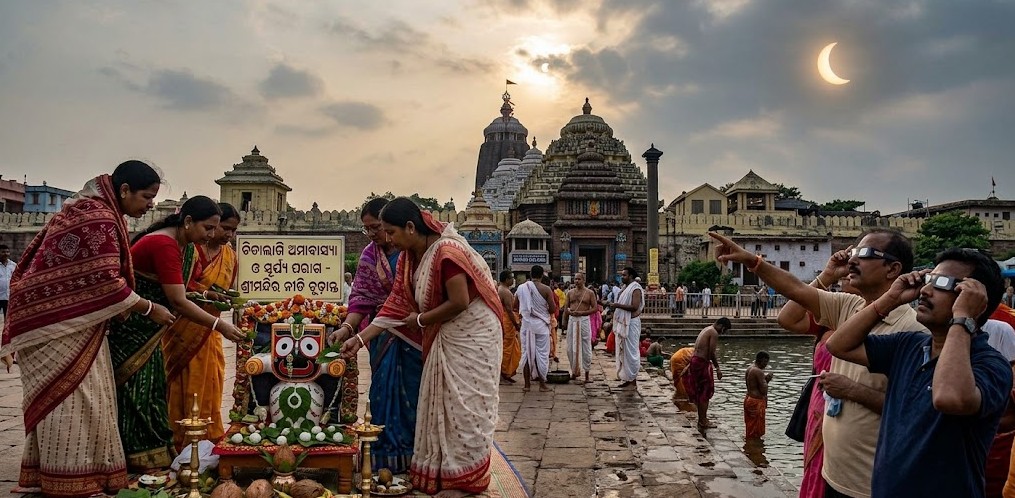
Representational Image
Astronomically, the eclipse is expected to produce a striking spectacle in parts of the world, with locations along the path of totality experiencing a brief period of complete daytime darkness.
However, there is no need for devotees in Odisha to follow eclipse-related rituals, experts said, as the celestial event will not be visible from India.
No eclipse rituals required in Odisha
Jagannath culture expert Suryanarayan Rath Sharma said the coincidence of Chitalagi Amavasya and the solar eclipse should not cause confusion among devotees.
On Chitalagi Amavasya, the deities at Puri Srimandir are traditionally adorned with the gem-studded Chitas, the distinctive forehead ornaments associated with Lord Jagannath and the other deities.
According to Sharma, since Wednesday’s solar eclipse will not be visible from Odisha or anywhere else in India, there is no requirement to observe eclipse-related restrictions in the state.
He said devotees can continue with the prescribed Chitalagi Amavasya rituals without being concerned about the eclipse occurring elsewhere in the world.
What does the eclipse mean astronomically?
A total solar eclipse occurs when the Moon moves directly between the Earth and the Sun and completely blocks the Sun’s visible disc for observers within the path of totality.
The total phase of Wednesday’s eclipse is expected to last around 2 minutes and 18 seconds.
The eclipse will be visible from parts of Europe and North America, while the path of totality will pass across regions including Greenland, Iceland and parts of northeastern Spain.
Some locations outside the path of totality will witness a partial eclipse.
According to astronomical calculations, the eclipse will begin at around 11:20 pm IST, making it invisible from India.
Experts explain religious significance
Astrologer Harishankar Mishra said eclipse-related restrictions are generally associated with an eclipse that is actually visible from a particular location.
He explained that the traditional practice of avoiding cooking and eating before an eclipse is not applicable when the celestial event cannot be observed from the region.
Mishra also highlighted the dramatic effect of a total solar eclipse in areas where it is visible. During totality, daylight can temporarily give way to darkness, stars may become visible and birds and animals can respond to the sudden change in light.
Chitalagi Amavasya rituals to continue
With the solar eclipse remaining invisible from India, religious experts have said there is no disruption to the observance of Chitalagi Amavasya in Odisha.
At Puri Srimandir, the focus will remain on the traditional rituals associated with the festival and the ceremonial adornment of the deities.
Thus, while the eclipse will create a rare celestial spectacle in parts of the world, devotees in Odisha can observe Chitalagi Amavasya without any additional eclipse-related restrictions.
Leave a Reply