Ahmedabad, Jan 07 : Urban planning in India must move beyond drawing city boundaries and focus on people, productivity and time efficiency, K. Srinivas, Secretary, Union Ministry of Housing and Urban Affairs (MoHUA), said on Thursday while inaugurating the 74th National Town & Country Planners Conference organised by the Institute of Town Planners, India (ITPI).
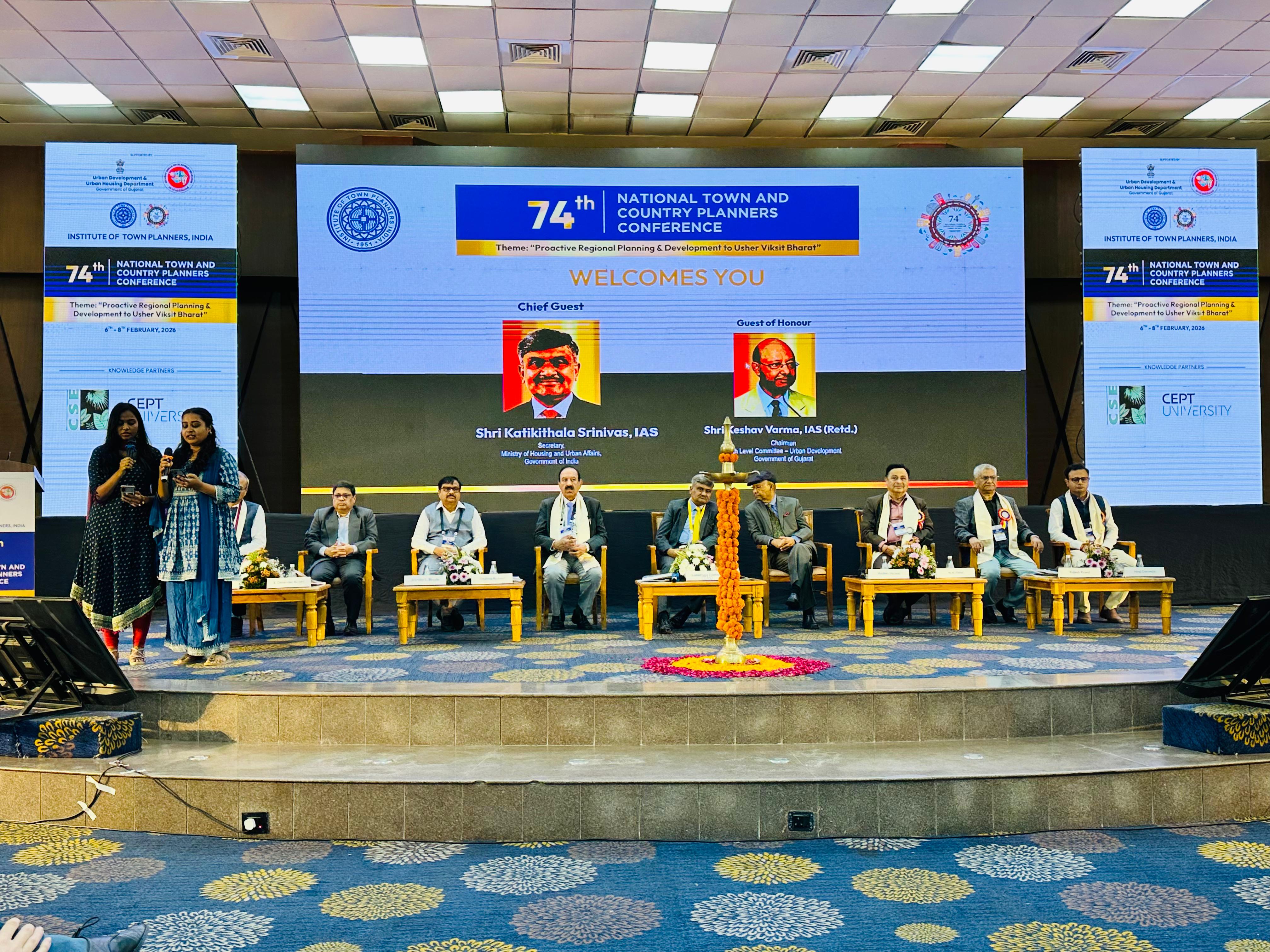
Mr. Srinivas said urbanisation has now been recognised as a positive force for economic growth, with town planners emerging as key stakeholders in India’s development story.
“It is no longer enough to design cities in kilometres. There is a need to design locally, design for people and, most importantly, design for time. In urban areas, time efficiency determines productivity, whether in mobility, housing, education or access to services,” he said.
Highlighting the scale of the challenge ahead, Mr. Srinivas noted that India is expected to add between 35 and 40 crore people to its urban population in the coming decades. He cautioned that despite significant progress, urban development continues to face structural issues such as weak municipal finances, rising costs of living, inadequate health infrastructure and a persistent disconnect between urban planning and economic planning.
“Planners are often seen as gatekeepers. The need of the hour is to become facilitators and drivers of development,” he said, calling for greater congruence between public investment in urban infrastructure and its economic impact.
Earlier, NK Patel, Patron and Past President of ITPI, said Gujarat was hosting the national conference after 13 years with the same enthusiasm and commitment to advancing the planning profession.
The three-day conference, themed ‘Proactive Regional Planning and Development to Usher Viksit Bharat’, has drawn around 500 participants from across the country. Key discussions on the first day focused on planning and development approaches for rapid transit corridors and metro cities regional planning for economic development.
In his address, ITPI President Pradeep Kapoor, stressed the need to move beyond city-centric master plans.
“No city can develop in isolation. Regional planning must take centre stage if we are to manage rapid urbanisation and move towards balanced growth, especially as India approaches 40% urbanisation before 2030,” he said.
Former Ahmedabad Municipal Commissioner Keshav Verma urged young planners to act as urban warriors and adopt a vision-driven approach.
“Business-as-usual planning has created inefficient and unhealthy cities. The paradigm must shift for greater focus on quality of life, sustainability, green spaces and people’ participation. Good urban planning is also good economics,” he said.
Darshna Vaghela, Minister of State for Urban Development, spoke about the state’s urban transformation over the past two decades and citied the approval of over 225 town planning schemes in the last three years. She urged planners to ensure cities evolve as liveable, inclusive hubs rather than concrete-dominated spaces.
The second day of the conference will include sessions on inclusive infrastructure planning for global events, climate literacy in academia and practice, AI application for sustainable planning and management, and lessons from 100 years of town planning schemes in Gujarat. Chief Minister Bhupendra Patel will be the chief guest at the valedictory session.