
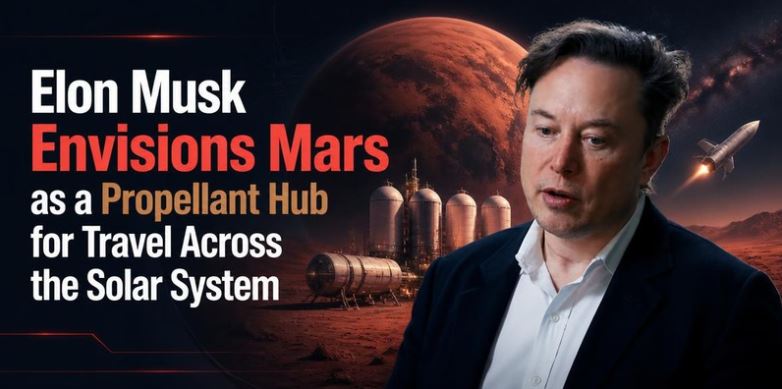
SpaceX CEO says Starship could enable missions to asteroids, Jupiter’s moons, Saturn and beyond with a propellant depot on Mars.
Oct 15: Elon Musk has outlined an ambitious vision for interplanetary transportation, suggesting that a propellant depot on Mars could transform SpaceX’s Starship into a reusable transport system capable of reaching destinations across the solar system.
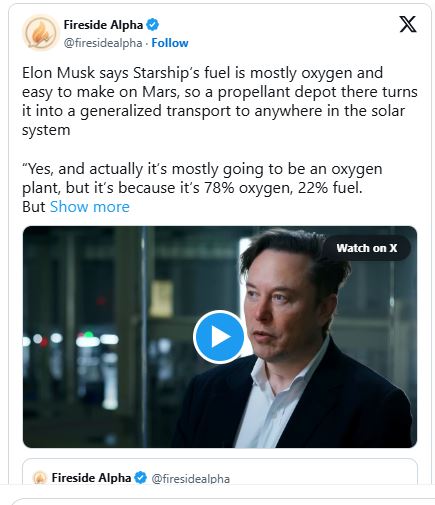
Elon Musk says Starship’s fuel is mostly oxygen and easy to make on Mars, so a propellant depot there turns it into a generalized transport to anywhere in the solar system “Yes, and actually it’s mostly going to be an oxygen plant, but it’s because it’s 78% oxygen, 22% fuel. But the fuel is a simple fuel that is easy to create on Mars and many other parts of the solar system.” “So basically, and it’s all propulsive landing, no parachutes, nothing thrown away, it has a heat shield that’s capable of entering on Earth or Mars.” “We could even potentially go to Venus, but you don’t want to go there. Venus is hell, almost literally.” “But you could, it’s a generalized method of transport to anywhere in the solar system because the point at which you have a propellant depot on Mars, you can then travel to the asteroid belt and to the moons of Jupiter and then to Saturn and ultimately anywhere in the solar system.”
— Fireside Alpha (@firesidealpha) October 15, 2026
According to Musk, Starship’s propellant requirements are dominated by oxygen, which accounts for approximately 78% of the propellant by mass, while the remaining 22% is fuel. He said the fuel is relatively simple to produce and could be manufactured on Mars and potentially at other locations across the solar system.
Musk’s vision centres on establishing a propellant production facility on Mars, allowing Starship to refuel locally rather than relying entirely on supplies transported from Earth. Such infrastructure could potentially support increasingly ambitious missions to distant destinations.
He also highlighted Starship’s fully reusable design, which relies on propulsive landings rather than parachutes. Its heat shield is designed to withstand atmospheric re-entry on Earth and Mars, supporting the spacecraft’s intended role as a reusable interplanetary vehicle.
Musk said the system could potentially even reach Venus, although he described the planet’s extreme environment as an undesirable destination.
Looking further ahead, he suggested that a propellant depot on Mars could serve as a strategic staging point for missions to the asteroid belt, the moons of Jupiter, Saturn and other destinations throughout the solar system.
However, turning this vision into reality would require major advances in space-based fuel production, long-duration missions, orbital refuelling and infrastructure development. Establishing reliable propellant production on Mars remains a significant technological challenge.
If achieved, Musk’s concept could reshape the future of space exploration by making Mars more than a destination—it could become a refuelling hub for humanity’s expansion across the solar system.
Leave a Reply