
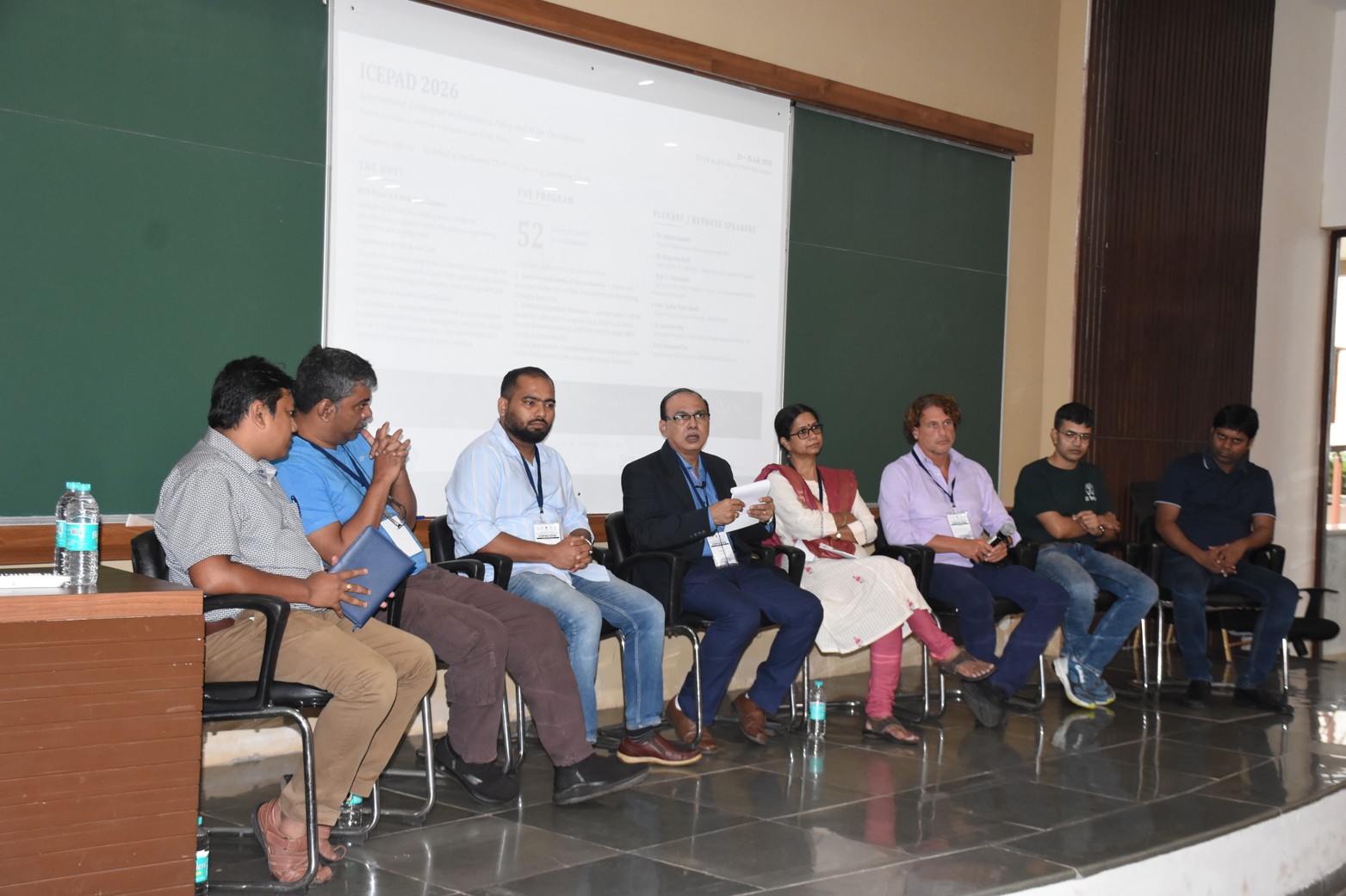
Goa, 3rd Aug: BITS Pilani Goa, in collaboration with the Center for Studies in Social Sciences, Calcutta (CSSSC), organized the International Conference of Economics, Policy and AI Development (ICEPAD 2026). The conference brought together leading economists, policymakers, researchers, industry experts, and academicians who are contributing deliberately to the increasing role of AI in shaping public policies, economic development, and governance.
The conference was organized around the theme of “Economics, Artificial Intelligence and Public Policy”. Through the keynote addresses and technical paper presentations, ICEPAD 2026 served as an interdisciplinary platform for discussing how AI is transforming economic research, fiscal policymaking, infrastructure financing, industrial development, and governance.
The conference was graced by Dr. Davide Furceri, Division Chief, Fiscal Policy and Surveillance Division, International Monetary Fund (IMF), who presented his research work titled “AI Meets Fiscal Policy: Mapping Government Spending Actions Across 64 Countries.” His presentation unveiled a landmark data initiative, “A Global AI-Narrative Database of Fiscal Policy Actions,” that was developed using Large Language Models (LLMs) to systematically identify and classify fiscal policy actions across under 142 countries. The database used in this research helps in enabling large-scale analysis of fiscal policy and opening new avenues for estimating country-specific fiscal multipliers.
Speaking about the event, Prof. Sandip Sarkar, Convenor, ICEPAD 2026 said, “ICEPAD 2026 has established a new direction for an interdisciplinary research agenda that brings together economics and AI driven technology to address emerging global challenges.”
The convergence between speed of public policy making and the speed of technology was the central theme of the conference, according to the conference organizers, Prof. Saibal kar, CSSS Kolkata and Prof. Snehanshu Saha.
The conference was addressed by various eminent speakers from leading academic and policy institutions. These included:
· Dr. Swaprava Nath from IIT Bombay explained the foundation of multi-agent AI through the lens of game theory and mechanism design
· Mr. Sujit Kumar, Chief Economist at NaBFID focused on the importance of infrastructure financing in achieving the vision of Viksit Bharat.
· Dr. Sanchari Roy from the University of Exeter Business School presented evidence on strengthening collective aspirations and cooperation among women’s self-help groups
· Prof. C. Veeramani (Centre for Development Studies) surveyed India’s evolving industrial policy through the experience of the mobile phone manufacturing sector
· Prof. Tushar Kanti Nandi from IISER Kolkata researched the implications of indirect tax design on trade networks
· Prof. Mausumi Das from the Delhi School of Economics discussed the relationship between capital scarcity, automation and economic growth in developing economies.
ICEPAD 2026 also showcased emerging research in economics, public policy and artificial intelligence through a rigorous academic program. After multiple rounds of scrutiny by experts in relevant fields, fifty-two research papers were selected. These papers will now be considered for publication in a special issue of the South Asian Journal of Macroeconomics and Public Finance after an additional round of the peer review process.
This conference reflects BITS Pilani’s continuous efforts in encouraging interdisciplinary research and developing platforms that focus on the complex societal challenges across academia, policy and industry. By bringing experts from different fields economics, public policy, and artificial intelligence ICEPAD 2026 strengthens the institutional vision of advancing research that contributes towards factual policymaking and sustainable development.
Leave a Reply