
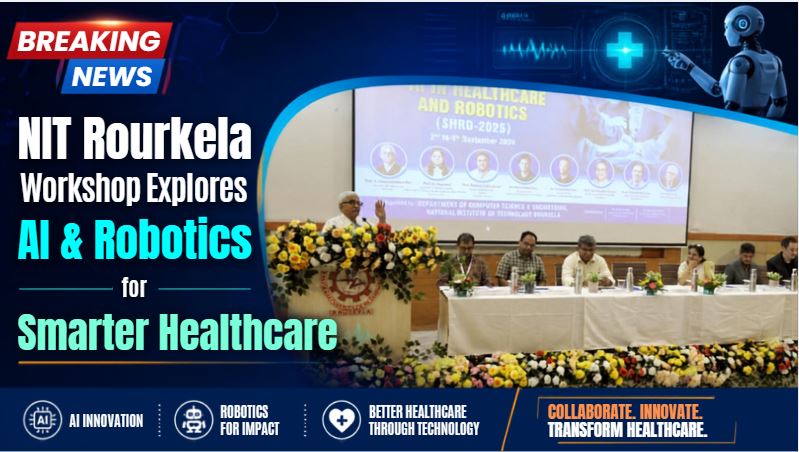
Rourkela, Sept. 8 (UDN): Artificial intelligence, robotics and advanced healthcare technologies dominated discussions at a three-day international workshop hosted by the National Institute of Technology (NIT) Rourkela, with experts and researchers examining how emerging technologies can address complex healthcare needs.
Global Academic Collaboration
The SPARC-supported International Workshop on “Smart Healthcare and Robotics” (SHRO-2026) was organised by NIT Rourkela’s Department of Computer Science and Engineering from September 2 to 4.
The programme was conducted under the Scheme for Promotion of Academic and Research Collaboration (SPARC) of the Ministry of Education and formed part of the academic and research partnership between NIT Rourkela and the University of Nebraska at Omaha, USA.
The workshop was coordinated by Associate Professors Dr Anup Nandy and Dr Ratnakar Dash.
The inaugural session was attended by NIT Rourkela Director Prof K Umamaheshwar Rao, Dr Anita Aggarwal, Scientist-F and Head, SEED, Department of Science and Technology, Government of India, and Prof Rabibrata Mukherjee, National Coordinator, SPARC and Professor at IIT Kharagpur.
Prof Mukul Mukherjee and Prof Philippe Malcolm from the University of Nebraska at Omaha also participated in the inaugural programme.
Focus on Emerging Healthcare Technologies
Welcoming the participants, Prof Pankaj Kumar Sa, Head of the Department of Computer Science and Engineering, underlined the need for interdisciplinary research to tackle emerging healthcare challenges.
Dr Anup Nandy outlined the objectives of the workshop, while Dr Ratnakar Dash delivered the vote of thanks.
The technical programme featured expert lectures from researchers and scientists representing the Department of Science and Technology, University of Nebraska at Omaha, CSIR-Central Mechanical Engineering Research Institute, Indian Institute of Science and IIT Guwahati.
Discussions covered areas including medical technology, gait and balance assessment, biomechanics, rehabilitation, human-robot interaction, soft robotics, deep learning applications in healthcare and nature-inspired robotic algorithms.
Hands-on Training in AI and Medical Applications
A major component of SHRO-2026 was its practical laboratory sessions, giving participants direct exposure to biomedical signal processing and machine learning methods.
The hands-on sessions focused on techniques for activity and health-state classification, medical image analysis and explainable artificial intelligence for clinical decision-making.
Organisers said the practical training was aimed at helping participants understand how computational tools can be translated into intelligent and potentially more accessible healthcare solutions.
Emphasis on Affordable Healthcare Innovation
The workshop concluded on September 4 with a valedictory programme and distribution of certificates.
Addressing the concluding session, Prof K Umamaheshwar Rao stressed the value of bringing together expertise from different disciplines to develop technology-based solutions to pressing societal challenges.
He said initiatives such as SHRO-2026 can strengthen international academic partnerships while encouraging research focused on affordable, dependable and accessible healthcare technologies.
The organising team acknowledged the support of the SPARC programme, Ministry of Education, NIT Rourkela administration, invited speakers, participants, faculty members, staff and student volunteers in conducting the workshop.
Leave a Reply