
Angul, Oct. 5 (UDN): In an Odisha that is rapidly embracing highways, digital connectivity and ambitious development projects, two remote villages in Angul district continue to wait for something far more basic—a road they can depend on.
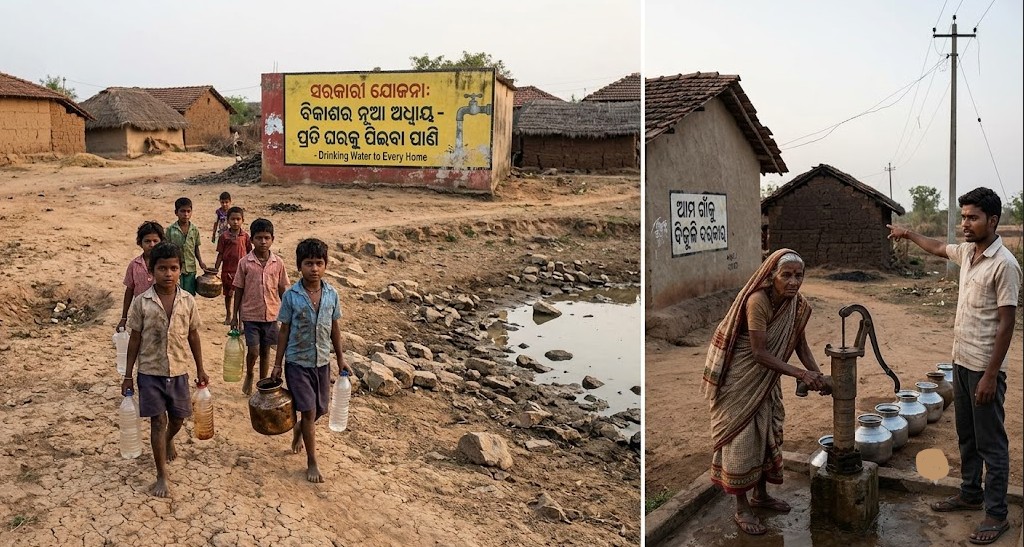
Representational Image
For residents of Kandha Koili and Siti Koili, under Manikjodi panchayat of Angul Sadar block, everyday life remains a struggle against poor road connectivity, inadequate healthcare access, teacher shortages, unreliable mobile networks and the constant threat of wild elephants.
Home to more than 200 families, the two revenue villages are located roughly 25 km from Angul. Yet reaching them can be far more difficult than the distance suggests.
A five-kilometre journey through the forest
Residents travelling from Antulia on the main road have to cover nearly five kilometres through a forest stretch to reach the villages. The road, they say, becomes particularly difficult during the monsoon, when mud, potholes and uneven surfaces make regular transportation almost impossible.
For many villagers, the poor road is not merely an inconvenience—it can become a matter of life and death.
Emergency vehicles, including 108 ambulances, often cannot reach the villages, residents allege. Pregnant women and critically ill patients are among those who face the greatest hardship, with families sometimes forced to carry patients manually across difficult stretches.
Auto-rickshaw services are also irregular because of the condition of the road.
“We have no proper road connectivity. During emergencies, ambulances cannot reach our villages. Pregnant women suffer the most, and sometimes patients have to be carried by hand,” said village chief Suresh Sandha.
When the road itself becomes a danger zone
Poor connectivity is compounded by another threat—wild elephants.
The villages are surrounded by forest, and residents say elephant movement has become a regular concern. Villagers worry about children travelling to school, people returning home after dark and even movement along the road during the daytime.
At times, residents claim, elephants block the road, leaving vehicles and people stranded.
With limited intervention, villagers have reportedly taken it upon themselves to clear vegetation along portions of the roadside to make the route more accessible.
A school, but not enough teachers
Education remains another concern.
A local school provides education up to Class VIII, but residents claim that the number of teachers is insufficient for the students enrolled there.
For parents in these remote communities, the concern extends beyond the classroom. A shortage of teachers could force children to travel farther for better educational opportunities—something that becomes difficult when transportation itself is unreliable.
Mobile phones without a network
The villages may no longer be completely untouched by modern technology. Mobile phones are available in many households.
But having a phone does not necessarily mean being connected.
Residents say mobile network coverage remains largely unavailable, making it difficult to contact relatives, access online services, communicate during emergencies or remain connected with the outside world.
In an emergency involving illness, accidents or elephant movement, the absence of reliable connectivity can make an already difficult situation even more dangerous.
Years of appeals, little change
Residents say they have repeatedly brought their problems to the attention of government officials and elected representatives.
According to them, the concerns include road connectivity, healthcare, education, communication facilities and protection from human-elephant conflict.
Yet they allege that meaningful improvement remains elusive.
“We have informed the District Collector, the BDO and other officials about our problems. But nothing substantial has changed,” Sandha claimed.
Officials remain cautious
When contacted about the situation, the Angul Sub-Collector reportedly declined to comment on camera.
The local BDO also did not provide a detailed response after a prolonged wait.
The BDO briefly said that the village road was under repair and that the work was in progress, while directing questions towards the Collector.
The response, however, offered little clarity on when the villagers could expect a durable road, improved healthcare access, adequate teaching staff or reliable mobile connectivity.
Development that has yet to reach the last mile
The situation in Kandha Koili and Siti Koili raises a larger question about rural development: How much of the state’s progress is actually reaching its most remote communities?
For families living in these forest-fringed villages, development is not measured by large projects or digital initiatives.
It is measured by whether an ambulance can reach a patient.
Whether a pregnant woman can safely travel to a hospital.
Whether a child can attend school without facing an elephant encounter.
Whether a phone can make a call when help is urgently needed.
And whether a road remains usable when the rain arrives.
Until those basic needs are addressed, residents of Kandha Koili and Siti Koili say the promises of development will remain distant from their everyday reality.
Leave a Reply